
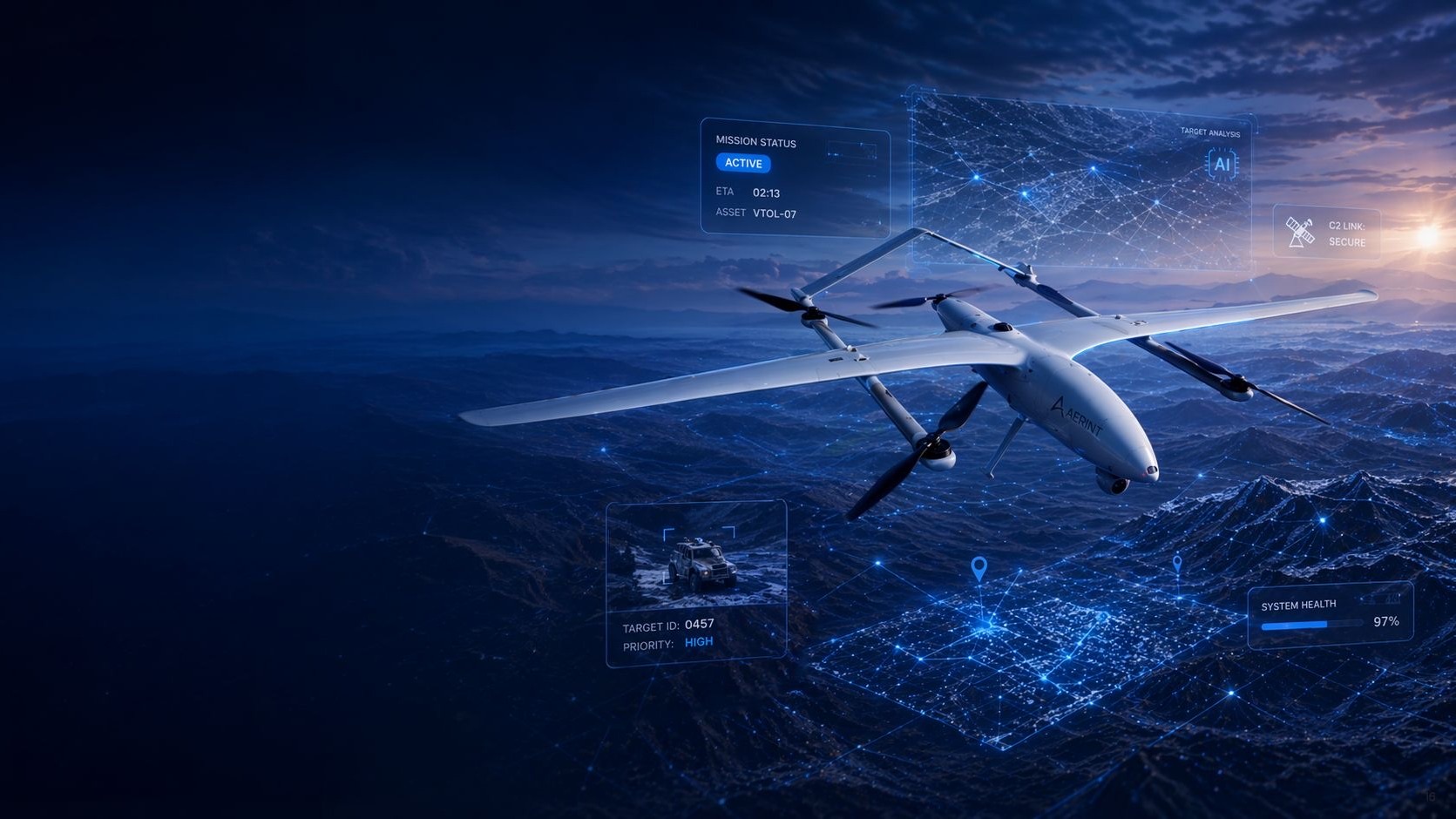
Intelligence onboard — not in the ground station.
GNSS-denied autonomy and proprietary end-to-end command and control. The aircraft navigates, decides and completes the mission on its own — including where satellite positioning is jammed, spoofed or absent.
Three properties, one platform
Autonomy makes mass deployment possible. Robust design makes mass production possible. Together they define a VTOL built for attrition warfare.
Fully autonomous
Takeoff, navigation, mission and landing with no pilot in the loop. A crew of two operates the full system.
GPS-independent
Vision-based navigation fused with inertial sensing. Full mission continuity under jamming and spoofing.
Robust & producible
Modular architecture — simple to build, simple to sustain, produced at rate.
Operational continuity where GPS fails
Navigation is solved onboard. Satellite positioning is treated as an input that may never arrive.
Vision-based navigation
Onboard vision fused with inertial sensing. No satellite dependency in the navigation solution.
Continuity under attack
Full mission continuity through jamming and spoofing — the aircraft keeps flying its mission.
Real-time adaptability
Decisions made onboard, in contested environments, without a link back to the ground station.
End-to-end execution
Takeoff, route, mission and landing executed autonomously as one continuous profile.
- Nav mode
- Vision + inertial
- GNSS
- Denied — continuity OK
- C2 link
- Secure
- Mission
- Active
One stack, from aircraft to operator
Autonomy onboard changes what the ground station has to do. It defines the mission — it does not fly the aircraft.
Proprietary end-to-end C2
Command, control and mission data run on one proprietary stack, from the aircraft to the operator.
Soldier-level operation
A two-person crew fields and operates the full system. Operators define missions rather than fly aircraft — no expert aircrew required.
Multi-aircraft operations
One operator, several aircraft — onboard autonomy carries the workload that a ground station cannot.
Built for mass production
The platform was designed to be built, not only to be flown. Rate is an engineering property of the architecture.
Modular architecture
Build once. Replicate everywhere.
Common platform
The G770 and the J613 share one line and one autonomy stack.
Produce closer
Replicate production cells with partners, next to the customer — scale in weeks, not years.
Scalability through replication — not through headcount.
See the autonomy stack in operation
Technical and operational briefings for defense, security and intelligence organizations.